| Tweet |

Custom Search
|
|
 
|
||
|
Shock
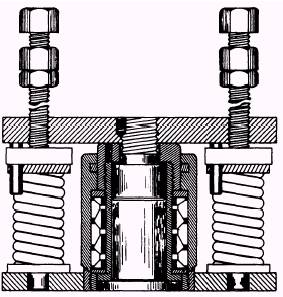
Absorbers Shock absorbers are used to absorb vibration forces that are greater than those originating in the engine. Such forces, or shock loads, may be induced by the detonation of depth charges, torpedoes, bombs, and other devices. The shock absorber operates on the same principle as the vibration isolator but provides additional support to protect the engine against severe shock loads. A type of shock absorber in use in the Navy is illustrated in figure 3-22.
Figure 3-22.Shock absorber,
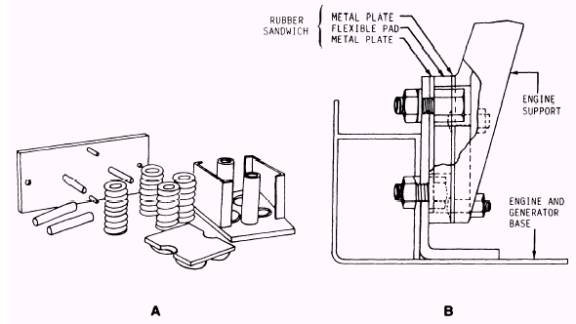
Figure 3-21.Vibration isolators. SUMMARY An understanding of the function or purpose of each part of a diesel engine is fundamental to safe operation and effective engine maintenance. This chapter has provided a description of the principal stationary parts and how these parts function as a group to maintain the major moving parts of the engine in their proper relative positions. The stationary parts include items such as the subbase, block or frame, oil pan, bearings, end plates, and cylinder assemblies. Except for the cylinder assemblies and bearings, these parts, as a group, are sometimes referred to as the frame, which is the load-carrying part of the engine. Cylinder assemblies complete the structural framework of an engine. In addition to forming the combustion space, parts of a cylinder assembly serve as a mounting place for other engine parts that are essential to engine operation. You should be familiar with the differences in design of these parts, as well as with the function of each part and how each part is related to the other parts of the engine. If your knowledge is weak in any of these areas, go back and review the information in this chapter before proceeding to chapter 4. |
||
|
||