| Tweet |

Custom Search
|
|
 
|
||
|
PRINCIPAL
MOVING COMPONENTS In this chapter, the PRINCIPAL MOVING COMPONENTS refer to the parts that convert the thermal energy released by combustion in the cylinder to mechanical energy. Mechanical energy then becomes available for useful work. The principal moving parts of an engine consist of the piston and connecting rod assemblies, crankshaft, bearings, and flywheel. Piston and connecting rod assemblies of an engine will include the piston, piston rings, piston pin, and connecting rod. These units and their functions in engine operation are discussed separately in the follow-ing sections. PISTONS As one of the major moving parts in the power-transmitting assembly, the piston must be so designed that it can withstand the extreme heat
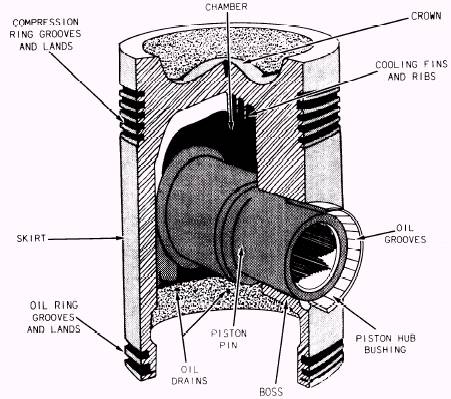
Figure 4-9.Piston nomenclature for a trunk-type piston. and pressure of combustion. Pistons must also be light enough to keep inertial loads on related parts to a minimum. The piston aids in sealing the cylinder to prevent the escape of combustion gases. It also transmits some of the heat through the piston rings to the cylinder wall. Pistons have been constructed of a variety of metalscast iron, nickel-coated cast iron, steel alloy, and aluminum alloy. Pistons of cast iron and aluminum are most commonly used at the present time. Cast iron gives longer service with little wear; it can be fitted to closer clearances, because it expands less with high temperatures, and it distorts less than aluminum. Lighter weight and higher conductivity are the principal advantages of aluminum pistons. Cast iron is generally associated with the pistons of slow-speed engines, but it is also used for the pistons of some high-speed engines. In these pistons, the piston walls are of very thin construction, requiring additional cooling. Pistons perform a number of functions. A piston, in addition to transmitting the force of combustion to the connecting rod and conducting the heat of combustion to the cylinder wall, may serve as a valve in opening and closing the ports of a 2-stroke cycle engine. |
||
|
||