| Tweet |

Custom Search
|
|
 
|
||
|
PISTON
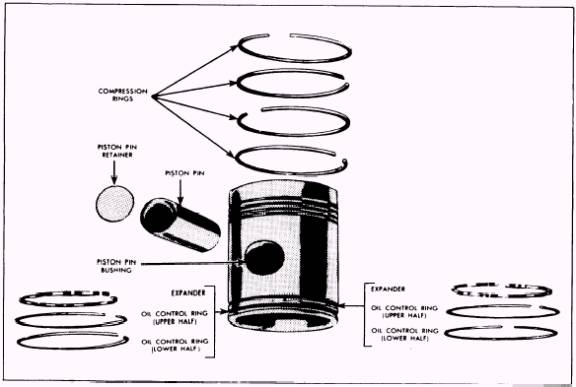
RINGS Piston rings are particularly vital to engine operation in that they must effectively perform three functions: seal the cylinder, distribute and control lubricating oil on the cylinder wall, and transfer heat from the piston to the cylinder wall. All rings on a piston perform the latter function, but two general types of ringscompression and oilare required to perform the first two functions. The number of rings and their location will also vary considerably with the type and size of the piston. Refer to figures 4-9, 4-10, and 4-12. In these figures, the compression rings are located toward the crown or combustion end of the piston. The ring closest to the crown is sometimes referred to as the FIRING ring. Two different examples of piston ring location are shown in figures 4-10 and 4-12. In figure 4-10, both compression and oil rings are located toward the crown above the pin bosses. In figure 4-12, the compression rings are located above the bosses and the oil rings are located below the bosses. The terms above and below adequately identify ring location when the crown of the piston is at the top, as it is in the in-line and V-type engines. These terms may lead to confusion, however, when reference is made to ring location on the upper pistons of opposed-piston engines. Piston ring location can be more accurately identified by reference to the crown or combustion end and to the skirt or crankshaft end of the piston. There are many variations in the design
Figure 4-12.Typical piston, piston rings, pin, and relative location of parts. of compression and oil rings. Some common variations are illustrated in figure 4-13. |
||
|
||