Custom Search
|
|
 
|
||
|
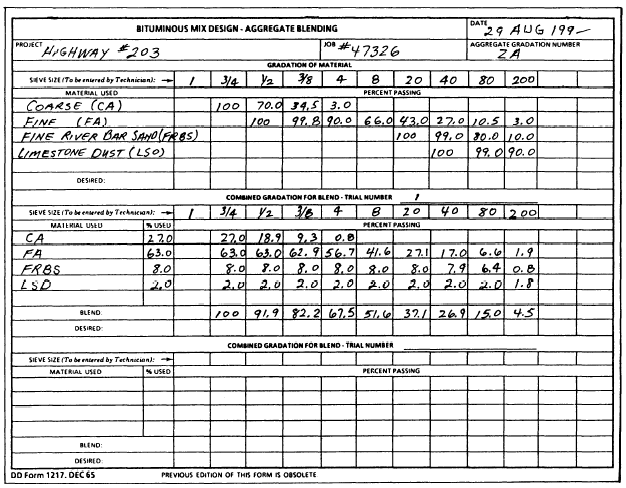
Selection of Sample Bitumen Contents Bitumen content for laboratory test mixes must be estimated to get the tests started. Tests are made with a minimum of five contents: two above, two below, and one at a content estimated to be about right. Bitumen content is expressed in terms of percentage of bitumen by weight to the total weight of the mix. Percentages commonly run from 3 to 7, depending upon the type of binder used and the specification requirements.Preparation of Aggregate A quantity of aggregate of the selected blend sufficient to make the required number of test samples is dried at 230F. The dry aggregate is separated into several size ranges by sieving, and a sieve analysis is then made of each range. From this procedure, design engineers can determine trial percentages for test blends. Test blends are then made with these trial percentages. Again, a sieve analysis is made, this time to determine a blending gradation, such as shown in figure 13-36. The explanation of figure 13-36 is as follows. The aggregate here was first sifted into four categories: coarse, fine, fine river bar sand (FRBS), and limestone dust (LSD)-the last being a commonly used mineral filler. All of the coarse aggregate consisted of material that would not pass the No. 8 sieve; 89.5 percent of fine aggregate consisted of material that would not pass the No. 80 sieve; and 90 percent of the FRBS consisted of material that would not pass the No. 200 sieve. These three sieves, then, were the ones used to make the original broad separation. Limestone dust was added to the extent of 2 percent. After the sample was broadly divided, a sieve analysis was made of each broad division category, as shown. This analysis was studied by experts, who estimated, among other things, the probable void percentages that would exist in pavements made with the aggregate used in various combinations. Percentages that would minimize void percentages were estimated. For trial blend No. 1, these percentages are listed under "percent used." The percentages are 27 coarse, 63 fine, 8 FRD, and 2 LSD. A blend containing these percentages was made, and again the material in each category was sieve-analyzed, as shown. From these individual analyses, the blend analysis (that is, the sieve analysis for the mixed blend) was determined by adding together the percentages in each column. Thus an aggregate gradation for the blend was obtained. If tests showed that this particular gradation produced a mix that met the specifications for the pavement, this gradation would be specified for the aggregate used in the highway. Specimen Mixing and Compacting for Testing To prepare an aggregate blend for testing, thoroughly mix and heat enough blend for two specimens (about 3,000 grams) to the desired mixing temperature. Trough the aggregate blend; then heat the test amount of bitumen to mixing temperature and pour it into the trough. Mix the aggregate and bitumen together thoroughly with a mechanical mixer if one is available. Then place the mix in a compaction mold and compact it with a tamper. Give the number of blows required to produce the density that will be attained under the traffic for which the pavement is being designed. NAVFAC DM-5.4, Civil Engineering, specifies 50 blows for secondary roads and 75 blows for
Figure 13-36.-Data sheet for aggregate gradation of trial blends (DD Form 1217). primary roads. Seventy-five blows produce the equivalent of a tire pressure of 200 psi; 50 blows produce the equivalent of a tire pressure of 100 psi. After the compaction process, place the mold in a bearing-ratio jack and extract the compacted sample with extraction equipment. |
 |
|
|
||