| Tweet |

Custom Search
|
|
 
|
||
|
REFRIGERANTS AND SAFETY PRECAUTIONS The refrigerants commonly used are fluids, and they are affected by heat, temperature, and pressure in a
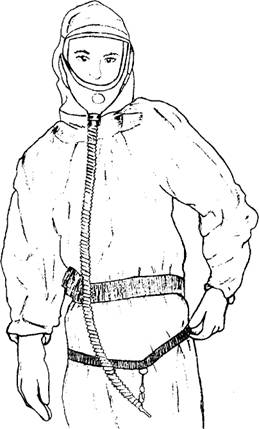
Figure 13-2.-Disposable protective coveralls and type C respirator. manner similar to water. Many different fluids are used as refrigerants; their selection is based on low boiling points and other desirable characteristics. The following refrigerants are the most commonly used on U.S. Navy ships: R-11, trichlorofluoromethane. R-11 is a colorless liquid or gas. At room temperature, R-11 has a slight ethereal odor (smells like ether or dry-cleaning fluid, tetrachloroethylene). R-12, dichlorodifluoromethane. R-12 is a colorless and odorless gas at room temperature. In high concentration, it has a slight ethereal odor. NOTE: Dichlorodifluoromethane (formerly F-12), is now called R-12. R-22, mono chlorodifluoromethane. R-22 is a colorless and odorless gas, which, at room temperature in high concentration, has a slight ethereal odor. R-114, dichlorotetrafluoroethane. R-114 is a colorless and odorless gas, which, at room temperature in high concentration, has a slight ethereal odor.
R-113, trichlorotrifluoroethane. R-113 is a heavy colorless liquid, which, at room temperature, has a slight ethereal odor. R-113 is only used as a solvent, degreaser, and flushing agent. It is not used as a shipboard refrigerant. These refrigerants, liquid and vapor, are nonflammable and nonexplosive. Air mixtures of these refrigerants are not capable of producing a flame. The products of decomposition have a pungent odor and are very irritating in minute quantities. They give ample warning before dangerous concentrations are reached. R-12, R-22, and R-114 are shipped under pressure in steel cylinders. R-11 and R-113 are normally shipped in drums, although some R-11 is shipped in cylinders for submarine use. The refrigerant cylinders are easily identified by their orange-colored bodies. In addition, the following markings are made on the cylinder to minimize the possibility of misidentification of the gas: The name of the gas is stenciled longitudinally on two diametrically opposite sides of the cylinder. A decal bearing the name of the gas may be attached to the shoulder of the cylinder 90 degrees from the stenciling. WARNING Do not smoke, braze, or weld when refrigerant vapors are present. Vapors decompose to phosgene, acid vapors, and other products when exposed to an open flame or a hot surface. The following safety precautions and warnings apply to all of the refrigerants listed in the previous paragraphs. 0 Exposure to large concentrations of fluorocarbon refrigerants can be fatal. Vapors displace air (oxygen) in a space and result in asphyxia. In high concentrations, these vapors have an anesthetic effect, causing stumbling, shortness of breath, irregular or missing pulse, tremors, convulsions, and death. Fluorocarbon refrigerants and solvents should, therefore, be treated as toxic gases. 0 Initial adverse anesthetic effects of R-113 can be experienced at much lower levels than those of other refrigerants, even though all refrigerants listed here have a threshold limit value (TLV) of 1,000 parts of refrigerant per million parts of air (ppm). Personnel overcome by inhalation of fluorocarbon vapors may develop cardiac problems. Remove exposed personnel to fresh air immediately. If breathing has stopped, apply artificial respiration. Do not permit affected personnel to exert themselves or to exercise. TLVs refer to airborne concentrations of substances and represent conditions under which it is believed that nearly all workers may be repeatedly exposed for an 8-hour day, 40 hours per week without adverse effects. In addition to the precautions previously stated, there are other safety measures that should be followed. A few of these methods and precautions are as follows: a Because refrigerants R-12 and R-22 boil at such low temperatures, they may freeze if they are splashed into the eyes or onto the skin. Always wear chemical safety goggles or a full face shield when you work with any refrigerant. Wear along-sleeved shirt and protective gloves. 0 Vapors of fluorocarbon refrigerants are four to five times heavier than air and tend to collect in low places. Perform refrigerant detection within 2 feet of the deck and in possible air pockets. * Refrigeration machinery spaces should be well ventilated, especially when personnel are servicing machinery. Use portable blowers if necessary to keep the refrigerant vapor levels below the TLV of 1,000 ppm. 0 Always have two people present when work is being done on refrigeration systems. Use a halide monitor with an alarm so you can be sure refrigerant vapor concentrations in a space do not exceed safe limits. |
 |
|
|
||